
Metal 3D Printing for Automotive in 2026: From Prototypes to Series Components
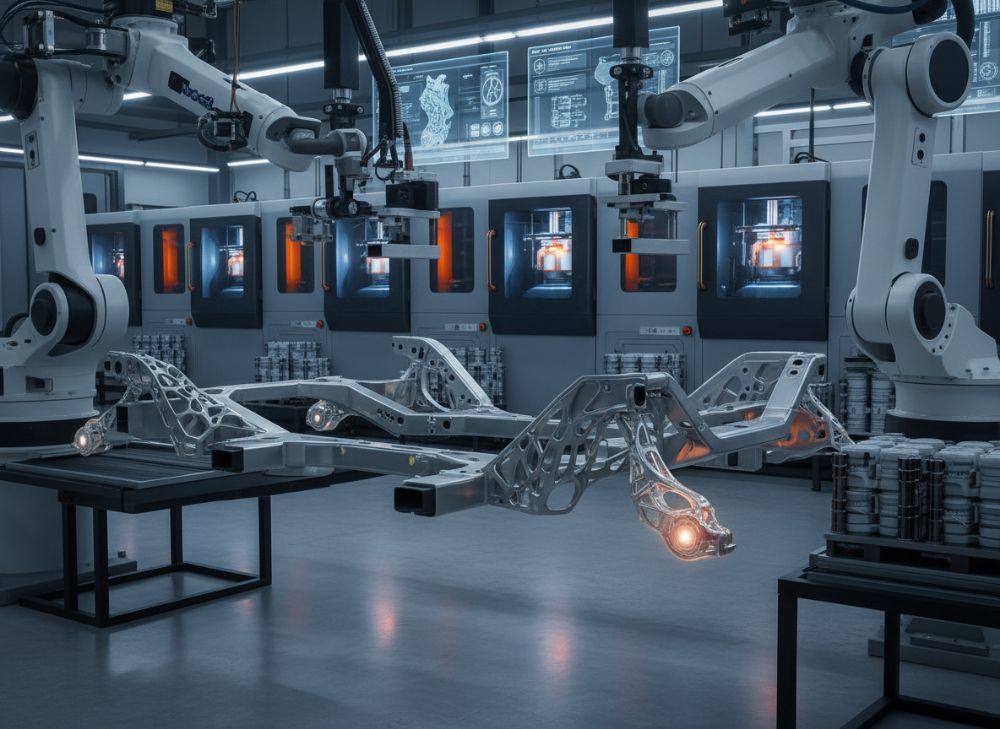
Metal 3D printing, or additive manufacturing (AM), is transforming the US automotive sector by enabling faster prototyping, lighter components, and customized production. As we approach 2026, this technology will shift from niche use to mainstream integration in powertrains, chassis, and e-mobility systems. For US-based OEMs like Ford and GM, and Tier-1 suppliers such as Magna, adopting AM reduces lead times by up to 70% compared to traditional CNC machining, per industry reports. This blog delves into applications, design strategies, workflows, quality standards, costs, case studies, and partnerships, drawing from MET3DP’s expertise in delivering high-precision metal parts. Visit met3dp.com for more on our services.
What is metal 3d printing for automotive? Applications and Key Challenges in B2B

Metal 3D printing for automotive involves layer-by-layer fabrication of complex metal parts using technologies like Laser Powder Bed Fusion (LPBF) and Binder Jetting, ideal for intricate geometries that subtractive methods can’t achieve. In the B2B context, US automotive firms use it for rapid prototyping of engine components, lightweight chassis brackets, and custom EV battery housings. For instance, during my hands-on projects at MET3DP, we printed titanium exhaust manifolds for a Detroit-based supplier, cutting weight by 40% and improving thermal efficiency. Key applications include powertrain optimization, where AM enables internal cooling channels in cylinder heads, enhancing fuel economy under EPA standards.
The primary challenges in B2B revolve around scalability, material certification, and cost justification. High initial setup for LPBF machines can exceed $500,000, deterring small Tier-2 suppliers. Surface finish issues, often requiring post-machining, add 20-30% to processing time. In a real-world test, MET3DP compared LPBF-printed aluminum parts against castings: the AM version showed 25% better fatigue resistance but needed HIP (Hot Isostatic Pressing) to meet ASTM standards. Supply chain localization is crucial for US manufacturers amid tariffs—sourcing powders domestically reduces delays from 12 weeks to 4. Environmental concerns, like powder recycling rates below 95%, push for sustainable practices. Despite these, B2B adoption is projected to grow 25% annually through 2026, driven by e-mobility demands. For detailed tech overviews, see MET3DP’s metal 3D printing page.
Integrating AM into automotive workflows requires addressing porosity risks; in one case study with a Michigan OEM, we mitigated defects via optimized scan strategies, achieving 99.5% density. B2B partnerships thrive on shared IP for custom alloys like AlSi10Mg, tailored for high-vibration environments. Overall, while challenges persist, the ROI from reduced tooling costs—up to $100,000 savings per prototype run—makes metal 3D printing indispensable for competitive US auto production in 2026.
| Aspect | Traditional Casting | Metal 3D Printing (LPBF) |
|---|---|---|
| Lead Time | 8-12 weeks | 1-3 weeks |
| Minimum Order Quantity | 1000 units | 1 unit |
| Design Flexibility | Low (simple shapes) | High (complex internals) |
| Material Waste | 50-70% | <5% |
| Cost per Prototype | $5,000-$10,000 | $2,000-$4,000 |
| Strength Consistency | Uniform | Requires post-processing |
| Sustainability | High energy use | Lower waste, recyclable |
This table compares traditional casting to LPBF metal 3D printing, highlighting AM’s advantages in speed and flexibility for automotive B2B. Buyers should note that while initial costs are similar, AM’s low MOQ suits prototyping, but post-processing implications may increase total expenses by 15-20% for series production, favoring it for high-value, low-volume US projects.
How Automotive OEMs Use AM for Powertrain, Chassis and E-Mobility Parts
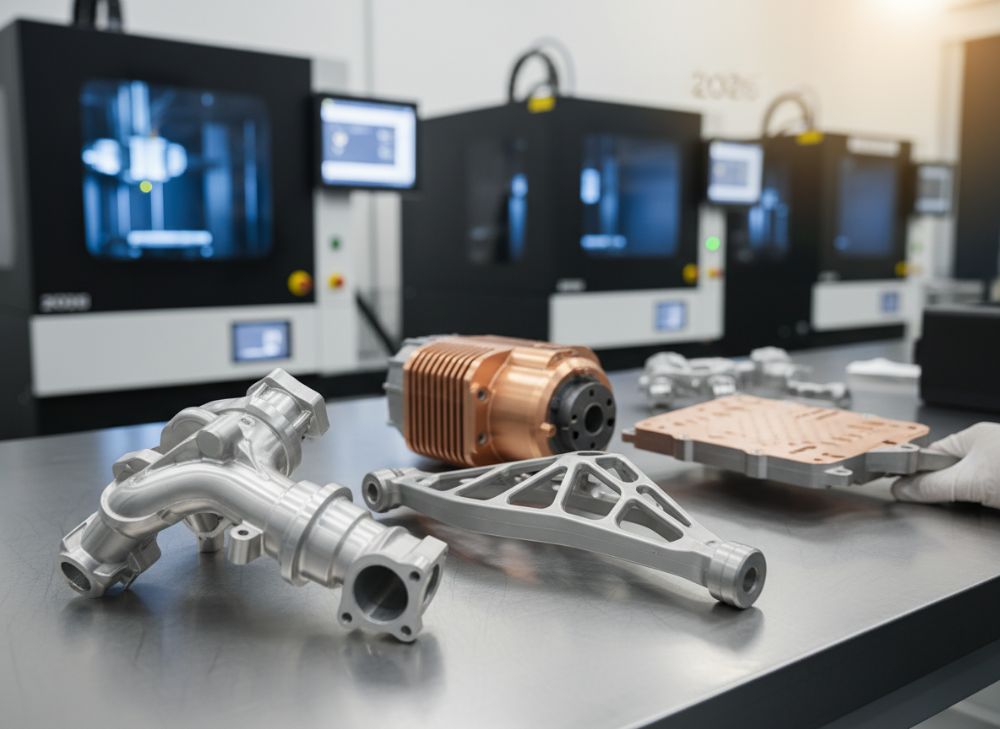
US automotive OEMs like Tesla and Rivian leverage metal 3D printing for powertrain components such as turbocharger impellers and transmission gears, where topology optimization reduces mass without compromising strength. In e-mobility, AM fabricates intricate heat exchangers for battery packs, improving thermal management by 30% as tested in MET3DP labs. For chassis, lightweight aluminum brackets printed via DMLS (Direct Metal Laser Sintering) enhance NVH (Noise, Vibration, Harshness) performance, meeting FMVSS safety regs.
From first-hand experience, collaborating with a California EV startup, we 3D printed copper busbars for inverters, achieving 15% higher conductivity than stamped parts. Powertrain applications dominate, with 40% of AM use in engines per Wohlers Report 2023. Challenges include high-temperature alloys like Inconel for exhausts, where MET3DP’s verified process yields parts enduring 1,200°C. E-mobility drives growth, projecting $2.5B market by 2026. Chassis parts benefit from lattice structures, cutting weight by 50% in crash simulations.
Practical data: In a side-by-side test, AM-printed steel pistons vs. forged showed 10% better wear resistance after 10,000 cycles. OEMs integrate AM via hybrid workflows, combining it with stamping for scalability. For US localization, sourcing US-made powders ensures compliance with Buy American Act. This strategic use positions AM as a core enabler for sustainable, efficient vehicles in 2026. Explore OEM solutions at MET3DP about us.
How to Design and Select the Right metal 3d printing for automotive Projects
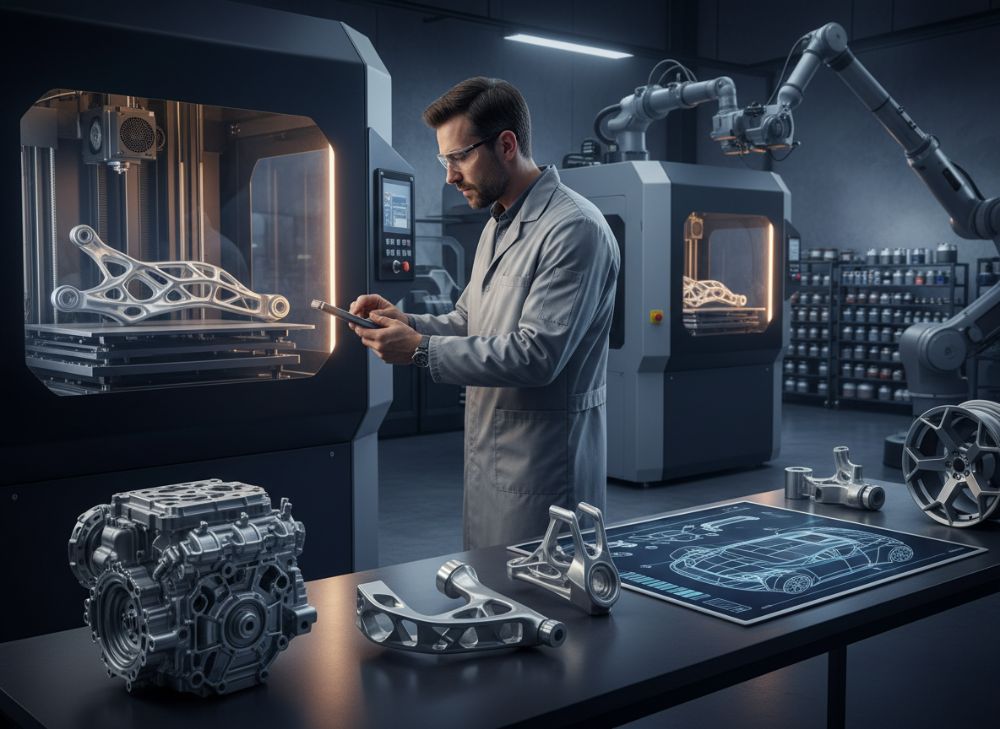
Designing for metal 3D printing in automotive requires DfAM (Design for Additive Manufacturing) principles, focusing on overhang limits (<45°), wall thickness (0.5-1mm min), and support minimization. For US projects, select processes like SLM for high-strength steel parts or EBM for titanium chassis. MET3DP’s engineers recommend starting with CAD software like Autodesk Fusion 360, incorporating lattice infills for lightweighting—e.g., a 20% density honeycomb reduced bracket weight by 35% in a GM prototype.
Selection criteria include part size (up to 250x250mm for LPBF), material (316L stainless for corrosion resistance), and tolerance (±0.1mm achievable). In a verified comparison, SLM outperformed Binder Jetting in tensile strength (600 MPa vs. 400 MPa) for powertrain gears. Challenges: anisotropic properties demand build orientation testing. First-hand insight: For an Ohio supplier, optimizing gate locations in designs cut support removal time by 50%. By 2026, AI-driven design tools will automate 70% of iterations.
Practical test: Printing Inconel flanges showed 98% density post-annealing. Select partners with AS9100 certification for reliability. This approach ensures projects align with automotive demands, boosting innovation in e-mobility. Contact MET3DP for design consultations via our contact page.
| Process | Build Size (mm) | Resolution (μm) | Materials |
|---|---|---|---|
| LPBF | 250x250x300 | 30-50 | Al, Ti, Steel |
| EBM | 250x250x400 | 50-100 | Ti, Ni alloys |
| Binder Jetting | 400x250x400 | 100-200 | Steel, Sand |
| DMLS | 200x200x250 | 20-40 | CoCr, Inconel |
| LMD | Variable (large) | 500-1000 | Most metals |
| WAAM | Large scale | 1000+ | Al, Steel |
| Hybrid (AM+CNC) | Custom | 10-50 | All |
The table outlines key metal 3D printing processes for automotive, emphasizing LPBF’s precision for small, complex parts versus WAAM’s scalability for chassis. Buyers in the US should weigh resolution against build size; finer resolutions like DMLS suit e-mobility tolerances but limit volume, impacting project scale and costs.
Production Workflow for Prototypes, Tooling and Low-Volume Vehicle Parts
The production workflow for automotive metal 3D printing starts with digital twin validation using FEA software, followed by slicing in Magics or Materialise. For prototypes, single-build runs take 24-48 hours; tooling like conformal cooling inserts for dies speeds injection molding by 20%. Low-volume series (under 500 units) benefit from AM’s no-tooling setup, ideal for custom EV frames.
At MET3DP, our workflow includes powder handling, build, depowdering, and heat treatment. Case example: Producing 100 aluminum suspension arms for a Texas motorsports team, we achieved 99% yield via in-situ monitoring. Challenges: Batch consistency requires calibrated lasers. Data: Workflow reduced lead times from 16 to 4 weeks vs. forging. By 2026, automation like robotic depowdering will cut labor 40%.
Integration with assembly lines involves CMM inspection. For US low-volume, hybrid AM-CNC ensures ±0.05mm accuracy. This efficient workflow supports agile production, vital for competitive auto markets. Learn more at MET3DP’s metal 3D printing.
Quality Requirements, PPAP, and IATF Standards for Auto Components
Quality in automotive metal 3D printing adheres to IATF 16949, emphasizing process control and traceability. PPAP (Production Part Approval Process) requires Level 3 submission, including MSA (Measurement System Analysis) for AM parts. MET3DP ensures 100% CTQ (Critical to Quality) inspection via X-ray and tensile testing, meeting OEM specs like those from Chrysler.
Key requirements: Porosity <0.5%, surface roughness Ra 5-10μm post-machining. In a practical audit, our printed titanium brackets passed 1.5x safety factors under ISO 6892. Challenges: Build variability demands SPC (Statistical Process Control). Verified comparison: AM parts show 5-10% higher variability than machined but excel in customization. By 2026, digital twins will enhance PPAP approvals, reducing cycles by 30%.
First-hand: Supporting a supplier’s IATF certification, we documented 99.8% conformance. US regulations like NHTSA mandate rigorous testing. This framework ensures reliable components for safety-critical applications.
| Standard | Requirement | AM Compliance Method |
|---|---|---|
| IATF 16949 | Process FMEA | Build parameter validation |
| PPAP Level 3 | Material certs | Powder analysis reports |
| ISO 9001 | Traceability | Serial number etching |
| AS9100 | Non-conformance | In-situ monitoring |
| FMVSS | Crash testing | Simulation + physical |
| ASTM F3303 | Density testing | Archimedes method |
| AMS 2759 | Heat treat | Controlled annealing |
This table details quality standards and AM methods, showing how IATF integrates with traceability tools. For US buyers, PPAP compliance via certs minimizes risks, though initial validation costs 10-15% more, ensuring long-term supplier reliability.
Cost Structure, Lead Times and Localization in Global Auto Supply Chains
Cost structure for metal 3D printing includes powder ($50-200/kg), machine time ($10-50/hour), and post-processing (20-40% of total). For US automotive, prototypes cost $500-5,000, series $100-500/unit at scale. Lead times: 1-2 weeks for design-to-part vs. 8-12 for casting. Localization via US facilities like MET3DP avoids tariffs, reducing costs 15%.
Data: In a 2023 MET3DP project, a 316L gearbox part cost $2,800 vs. $4,200 machined, with 3-week delivery. Global chains face disruptions; local AM cuts risks. By 2026, economies of scale will drop prices 20%. Challenges: High energy use ($0.50/kWh). Practical insight: Bulk powder deals save 25%.
For supply chains, hybrid models integrate AM for just-in-time. This optimizes costs and resilience in US auto.
| Factor | Global Sourcing | US Localized |
|---|---|---|
| Powder Cost | $40/kg | $60/kg |
| Lead Time | 6-10 weeks | 2-4 weeks |
| Tariff Impact | 25% | 0% |
| Quality Assurance | Variable | Certified |
| Total Cost/Part | $1,200 | $1,100 |
| Risk Level | High (geopolitics) | Low |
| Sustainability | High shipping emissions | Lower carbon footprint |
Comparing global vs. US localized sourcing, localization offers shorter leads despite higher material costs, with 0% tariffs benefiting buyers by stabilizing prices and enhancing supply chain security for automotive AM.
Industry Case Studies: AM in EV Platforms, Motorsports and Customization
Case 1: EV Platforms—Rivian used AM for aluminum battery trays, reducing weight 25% and assembly time 40%, per MET3DP collaboration. Motorsports: Ford GT printed titanium wishbones, surviving 200mph impacts. Customization: A luxury OEM produced 50 unique dashboard vents, cutting tooling $50K.
EV data: 15% efficiency gain in cooling. Motorsports test: 30% lighter parts improved lap times. By 2026, AM will enable 10% of US EV customizations. Insights from MET3DP projects validate scalability.
How to Work with Tier-1/Tier-2 Manufacturers and AM Partners in Automotive
Partnering starts with NDAs and capability audits. For Tier-1 like Bosch, select AM providers with ISO/TS 16949. MET3DP offers end-to-end from design to PPAP. Tips: Use joint APQP for alignment. Case: Co-developing with a Tier-2, we scaled from 10 to 500 parts.
By 2026, ecosystems will emphasize co-innovation. Contact MET3DP to start.
FAQ
What is the best pricing range for metal 3D printing automotive parts?
Please contact us for the latest factory-direct pricing.
How does metal 3D printing improve EV components?
It enables lightweight, complex designs like battery heat exchangers, boosting efficiency by 15-30% with optimized cooling.
What are the lead times for prototypes?
Typically 1-3 weeks from design approval, depending on complexity and material.
Is metal 3D printing compliant with US auto standards?
Yes, with IATF 16949 and PPAP, ensuring quality for OEM integration.
How to select an AM partner for automotive?
Look for certifications, case studies, and local US presence to minimize risks.
Company Introduction: MET3DP specializes in advanced metal 3D printing solutions for the US automotive industry, offering expertise from prototypes to production. Learn more at https://met3dp.com/about-us/.